SMART, BLET to fight KCS in-cab cameras - 5/13/2013

KCS_rail_logoDuring a meeting with the presidents of the Brotherhood of Locomotive Engineers and Trainmen and the SMART Transportation Division on April 24, 2013, Kansas City Southern Railway announced that it intends to install and begin to use inward facing cameras in all of its locomotives over the next few weeks.

According to KCS, each locomotive will have two cameras – one behind the engineer focused on the control panel, and one across the cab focusing on both crew members. (Some locomotives with cameras installed already are in use in Mexico; others are being fitted for cameras in Shreveport.)

The carrier told the two presidents that it has “management prerogative” to take these actions and does not have to, and does not intend to, bargain with the unions over the use of these cameras, or the effects of this dramatic change on its operating craft employees.

Without notifying the unions, that same day KCS filed suit in federal district court in Shreveport, La., to obtain a ruling allowing it to implement its plan. Upon learning of these developments, BLET National President Dennis Pierce and Mike Futhey, President of SMART Transportation Division, together told the carrier that both unions vehemently disagree that the carrier has the right to install and use inward-facing cameras unilaterally without exhausting the bargaining processes of the Railway Labor Act.

The two presidents and the leadership of both unions view this as a serious change in working conditions and have agreed to work closely to resist its implementation. A coordinated effort is being undertaken in response.

Not only will both unions be fervently opposing KCS’s lawsuit, they will be asking the court to enjoin the carrier from going ahead with its plan.

As of now, and until the court has issued a ruling regarding the parties’ respective rights, the carrier has agreed not to turn on or use the cameras.

Union members who work for KCS on a locomotive that has a camera installed should request assurances from the proper carrier officials that the camera is not turned on and not in use. Any instance where that assurance is not given should be immediately reported to your general chairperson.

Also, to avoid any possibility of discipline, no member should attempt to move, cover or otherwise tamper with the cameras they encounter. Cooperation in this manner is vital.

Lastly, train and engine employees can be assured that their unions are diligently working to protect them and their interests in this matter. No legal stone will be left unturned in opposing the carrier on this issue.

>>>
Bill Gates ups CN Rail stake to 12% - 5/13/2013

Bill Gates has increased his overall investment in Canadian National Railway Co. to 12% for a combined value of roughly $4.7-billion.

Cascade Investment LLC, a Kirkland, Wash., investment company owned and controlled by the billionaire Microsoft founder, said Tuesday it had acquired an additional 13,670 common shares in CN for $1.25-million. The additional shares brings Cascade’s overall stake the country’s largest railway to 10% of its outstanding shares, or roughly 43 million shares.

>>>
Strong CN Rail gains stark reminder of CP Rail struggles - 5/13/2013

CN’s gains during the quarter were made on the back of higher freight volumes, better pricing and milder weather, the company said.
Handout/CNCN’s gains during the quarter were made on the back of higher freight volumes, better pricing and milder weather, the company said.

Canadian National Railway Co. delivered first-quarter results Monday that blew past expectations and highlighted the underperformance of its smaller rival, Canadian Pacific Railway Ltd.

“Our [first-quarter] results were helped by a milder winter throughout our serving territories. But make no mistake, these results are about strong execution,” said Claude Mongeau, CN’s chief executive, on a conference call.

“Whether it’s growth. Whether it’s efficiency. Whether it’s safety. Our agenda is working and it’s showing through in very solid financial results.”

>>>
Boom Times on the Tracks: Rail Capacity, Spending Soar - 4/1/2013

Boom Times on the Tracks: Rail Capacity, Spending Soar

By BETSY MORRIS

[image]Brandon Thibodeaux for The Wall Street Journal

Containers are loaded onto a train at the BNSF facility in Fort Worth.

EPPING, N.D.—On a recent subzero day at a rail station here on the plains, a giant tank train stretches like a black belt across the horizon—as far as the eye can see. Soon it will be filled to the brim with light, sweet crude oil and headed to a refinery on Puget Sound. Another mile-long train will pull in right behind it, and another after that.

Increasingly, scenes like this are being played throughout the country. "Hot Trains" dedicated to high-priority customers like United Parcel Service Inc. UPS +0.51% roar across the country to deliver everything from microwaves to tennis shoes and Amazon.com AMZN +1.65% packages.FedEx Corp., FDX +0.72% known for its huge fleet of aircraft, is using more trains, too.

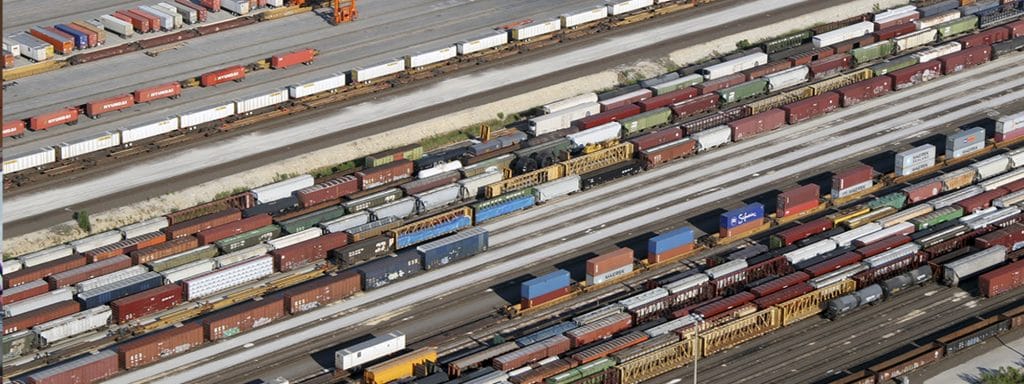
Welcome to the revival of the Railroad Age. North America's major freight railroads are in the midst of a building boom unlike anything since the industry's Gilded Age heyday in the 19th century—this year pouring $14 billion into rail yards, refueling stations, additional track. With enhanced speed and efficiency, rail is fast becoming a dominant player in the nation's commercial transport system and a vital cog in its economic recovery.

[image]

This time around, though, the expansion isn't so much geographic—it is about a race to make existing rail lines more efficient and able to haul more and different types of freight. Some of the railroads are building massive new terminals that resemble inland ports. They are turning their networks into double-lane steel freeways to capture as much as they can get of U.S. freight demand that is projected to grow by half, to $27.5 billion by 2040, according to the U.S. Department of Transportation. In some cases, rail lines are increasing the heights of mountain tunnels and raising bridges to accommodate stacked containers. All told, 2013 stands to be the industry's third year in a row of record capital spending—more than double the yearly outlays of $5.9 billion a decade ago.

And in a turnabout few could have imagined decades ago, rail is stealing share from other types of commercial transport—most notably the trucking business, which is waylaid by high fuel prices, overloaded highways, driver shortages and regulations that are pushing up costs.

Transport by rail is also relatively cheap. Though rising, U.S. freight rail rates are nearly half what they were three decades ago, according to the Association of American Railroads. And those bargains are helping to make manufacturing in North America cost effective again. Since 2007, more than $100 billion of foreign direct investments have been made in Mexico, Robert KnightUnion Pacific UNP +1.64% Chief Financial Officer, told analysts at a recent conference. He expects annual production of 2.7 million vehicles in that country to increase by another million by 2015.

"We wouldn't have as many companies considering moving back to the U.S. or near-shoring," if not for rail, says Yossi Sheffi, Professor of Engineering Systems at MIT and director of its Center for Transportation and Logistics. "Some of it is the cheaper energy. But we could not be moving the oil around without rail. We could not have the huge amount of imports without the rail."

image
Brandon Thibodeaux for The Wall Street Journal

Trucks, which compete with trains, haul loads to the facility, below.

image
Brandon Thibodeaux for The Wall Street Journal

A ground man climbs onto a car as containers are loaded onto a train at the BNSF Intermodal Facility.

A confluence of other factors is advancing the trend. The energy boom, for instance, is reviving industries like steel and chemicals. Higher labor and transportation costs in parts of Asia are triggering a surge in sourcing from nearby.

"All those things have put the railroads into a great sweet spot for what's next in this economy," says Matthew K. Rose, chief executive officer of BNSF Railway. "Nobody wants to miss out."

BNSF, purchased by Warren Buffett's Berkshire Hathaway Inc. BRKB +1.37% in 2010, is investing $4.1 billion on a list that includes locomotives, freight cars, a giant terminal southwest of Kansas City and new track and equipment for its oil-related business in the Bakken shale region of North Dakota and Montana.

Union Pacific Corp. is spending $3.6 billion on a giant terminal near Santa Teresa, N.M. It is designing a new $400 million-$500 million bridge over the Mississippi at Clinton, Iowa, to replace an old drawbridge that routinely delays trains for hours at a time. It will double some track in Louisiana and Texas and expand rail yards there and in Arkansas to provide more capacity to chemical customers such as Dow Chemical Co. DOW +0.09% and Exxon Mobil Corp.XOM +1.23%

CSX Corp. CSX +1.04% will spend $2.3 billion partly to finish the first phase of a multiyear project, raising highway bridges, enlarging mountain tunnels and clearing some 40-odd obstacles to make enough space to accommodate double-decker containers all the way from the Midwest to the mid-Atlantic ports.

Kansas City Southern Railway Co. will spend $515 million. "We're a growth railroad," David Starling, its chief executive, told a securities analyst who questioned the expenditure in January. "The worst thing this team wants to be accused of is having some service deterioration because we didn't have the foresight to spend the money."

Passenger rail is undergoing something of a renaissance, too. It was the passenger business that nearly killed the freight business in the 1960s and 1970s. Part of the legislation designed to save the railroads in the 1970s allowed them to shed the passenger business. Lately, the Obama administration has invested nearly $12 billion in passenger rail, according to the Department of Transportation, that has been used to fund 152 projects in 32 states.

Trains may seem like relics of a bygone era. Not so. Steeled by a near-death experience in the 1970s—when many railroads filed for bankruptcy and braced for the threat of a government takeover—the railroads instead were largely deregulated. The survivors fought hard. They squeezed capacity, resolved labor issues, swallowed up weaker players and rebuilt. By the time rail's prospects began to brighten a decade ago, the executives were "a much younger, more IT, more metric-minded group," says William Galligan, vice president of investor relations at Kansas City Southern KSU +2.56% . "They had a whole new view toward how you run a railroad."

WSJ on Trains

[image]Daniel Machalaba

Read some of the Journal's past articles on trains and railroads.

On long distances, trains have been cheaper than trucks for decades. They can move one ton about 500 miles on one gallon of fuel, which makes them three to four times more fuel efficient. Yet they were notoriously unreliable. In logistics, trucks and planes typically arrived on time. Trains, conversely, were known as "the black hole of rail," says Prof. Sheffi. Eight years ago, he says he waited a full month for a train to deliver a new car from Ohio to Boston.

Curtis Whalen, an executive director of the American Trucking Associations, says trucks "compete in all various modes and we have some advantages." Trucks, he says, are still generally more reliable [than trains]," he says. "Our [data] shows that our truck transportation numbers are not going to be diminished by rail over any kind of time period."

In the past decade, though, under pressure from customers like UPS, trains have become more dependable. UPS "trained us in what it means to perform to their very high standards," says Mr. Rose at BNSF. "I'm sure there were many times they were very frustrated."

"I don't know if we're the largest customer [of the railroads] but I would tell you we're certainly the most demanding," says Ken Buenker, a vice president in UPS's Corporate Transportation Group. UPS's goal is an on-time arrival rate of 99.5%, he says. "So think about how much you risk with a train." One breakdown could delay many deliveries.

Railroads used technology and strategy to tackle such problems. They used sensors to detect mechanical issues before they caused delays. They developed their own version of the airline "hub and spoke system" and organized shipments in trains all bound for the same destination. The latter move eliminated the time- and labor-wasting stops to break trains apart and reset them. It also paved the way for longer and speedier itineraries. Railroads "are always talking about efficiency and speed," says Mr. Buenker. "The velocity of the network is really key for them."

image

Railroads, though, can't be entirely sure of clear track ahead. "There are certainly things that concern us," says Union Pacific Corp.'s chief executive, Jack Koraleski, like juggling capital investments with return to shareholders amid constant concerns about regulation that might tie their hands. Some shippers protest increased rail rates, saying they result from lack of competition. They are urging the Surface Transportation Board to act, and the board is studying the issue. Rail executives say their rates are market-based—just like their customers' are.

Tom Sangalli, director of the Container Store Inc.'s logistics and transportation, used to rely on trucks. He had begun testing rail two years ago, concerned that trucks were breaking down and missing important store delivery schedules. Trains, he thought, might offer a few advantages. Instead, he found many. Rail, he says, cut his transportation costs by 20% on average. On problem routes, the cuts were about 40%. He says he has also reduced his 46-cent a mile fuel surcharge by half, and his company's carbon footprint by 40%.

Importantly, Mr. Sangalli's deliveries arrive on time. "I know as soon as I hand it off to BNSF it'll arrive in three days," he says. Now, when Container Store opens a new store, he says, "the first thing we look at is can we get to it on rail?"

Mr. Whalen, of the trucking associations, says he is "unaware of any data or reports that show that rail beats trucks" when it comes to on-time deliveries. "At the end of the trip, you still normally use a truck," he says. "Rails just don't go everywhere."

In the U.S. oil boom, rail's new attitude has made it both a preferred mode of transport—and also an instrument of arbitrage. When oil began flowing in North Dakota, BNSF was perfectly situated. Its Burlington Northern Line from Minneapolis-St. Paul to Puget Sound cuts diagonally northwest through 16 of the 19 top oil-producing counties in North Dakota, then parallels the Canadian border through five of the six top-producing oil counties in Montana. Until several years ago, though, it was mostly a high-speed route for loads like lumber from the Northwest and grain from the Great Plains.

image

Then, in 2009, BNSF's Mr. Rose had dinner withEOG Resources Inc.'s EOG +4.02% chief executive officer, Mark Papa, at the Four Seasons in Houston. Mr. Papa said he had a new technology that was going to produce oil, but "he didn't have a way to get it out of North Dakota," Mr. Rose recalls. There wouldn't be enough pipeline capacity.

Oil nearly always travels below ground—by pipeline. Unlike pipelines, which travel between two fixed points, trains can transport the oil in many more directions. They also let producers go where the demand is—taking advantage of spreads of as much as $25 a barrel in markets pipelines can't reach.

Until recently, "crude by rail" was just an experiment. But by November, big oil players had carved out a plan here, dooming a new pipeline project in favor of a dozen rail-loading sheds. By year's end, more oil was moving out of North Dakota by rail than by pipeline.

BNSF had hauled its own fuel, "but nothing of this magnitude," Mr. Rose recalls.

The railroad had to set up a network to handle the new business. "If we do it, we've got to do it in long unit trains to be able to compete with the pipelines, and we've also got to build big loop tracks into your facilities to get trains in and out in an efficient manner," he told early customers. "All along, we talked amongst ourselves: is this a short-term deal or a long-term deal," he recalls. He was dubious.

But EOG's interest attracted other producers, who began leasing tank cars, buying land and putting up rail loading buildings. As a modern-day gold rush unfolded, BNSF added track, replaced rail, upgraded signals and hired hundreds of new employees. BNSF expects to increase daily crude oil shipments this year to 700,000 barrels from 500,000 at the end of last year, says Mr. Rose.

On a recent winter day near Minot, N.D., BNSF crews worked feverishly, despite numbing minus-23 degree temperatures, to repair frozen parts that were jamming the brakes of eight tank cars. Their hands were cold despite gloves, but nobody wasted time to warm them. They wanted to get the tank cars back online. They were in a race against OPEC, China, Brazil. They were part of the new pipeline.

A version of this article appeared March 27, 2013, on page A1 in the U.S. edition of The Wall Street Journal, with the headline: Boom Times on the Tracks: Rail Capacity, Spending Soar.

>>>
“Nurse line” offers answers to medical questions - 2/23/2013

Members covered by Aetna, Highmark Blue Cross Blue Shield or UnitedHealthcare seeking information about treatment options, chronic conditions or answers to other health-related questions can call a “nurse line” for answers 24 hours a day, every day.

This free service can help you with losing weight, managing stress, quitting tobacco and much more. More importantly, the nurse line offers you information, motivation, encouragement, and the one-on-one support that can make a real difference in your health – to stay well, get well or manage a health condition. 

You or one of your dependents can call your plan’s nurse line for:

• Learn about any health topic that concerns you;

•Change a behavior, like smoking or overeating, that affects your overall health;

•Gather information about a recent diagnosis;

•Learn about symptoms for certain illnesses and diseases;

•Find out about your medications;

•Understand an upcoming test or procedure;

•Make an informed medical or surgical health care decision;

•Follow through with a treatment plan;

•Manage a chronic condition, like asthma or diabetes, more effectively;

•Understand treatment options;

•Learn how to handle symptoms to avoid emergency room visits;

•Find ways to reduce risks associated with the condition. 

To take advantage of this valuable resource, simply call the number on the back of your medical identification card anytime, or refer to the numbers below: 

Aetna: (800) 556-1555

Highmark Blue Cross Blue Shield: (888) BLUE-428

UnitedHealthcare: (866) 735-5685

>>>

Welcome to the Local 582 Website

Sofa 3rd quarter 2012 available on downloads page

New Conductor Certification information on links page under FRA.

The new seniority Rosters are posted and available on downloads page.

Crew Talk Board Codes and Station ID's Available on downloads page.

Amendment to Current Agreement: Merrillan/Arcadia have been moved from Home Terminal 2 "Wisconsin Rapids" to Home Terminal 3 "Taylor"

All members are encouraged to donate to UTU Pac $10 dollars a month goes a long way. For information and forms contact either Jeff Thompson, or Matt Winkleman.

Our current officers are as follows:


LCA Officers :

Local Chairman: Jim Green

Vice Local Chairmen:

                                                  Ed Anglemyer

                                                  Brian Buza

                                                  Kyle Glodowski

                                                  Todd Burg

Local Officers :

President: John Pennington

Vice President: Adam Fenlaciki


Secretary and Treasurer: Matthew Winkelman

Legislative Representative: Jeff Thompson